
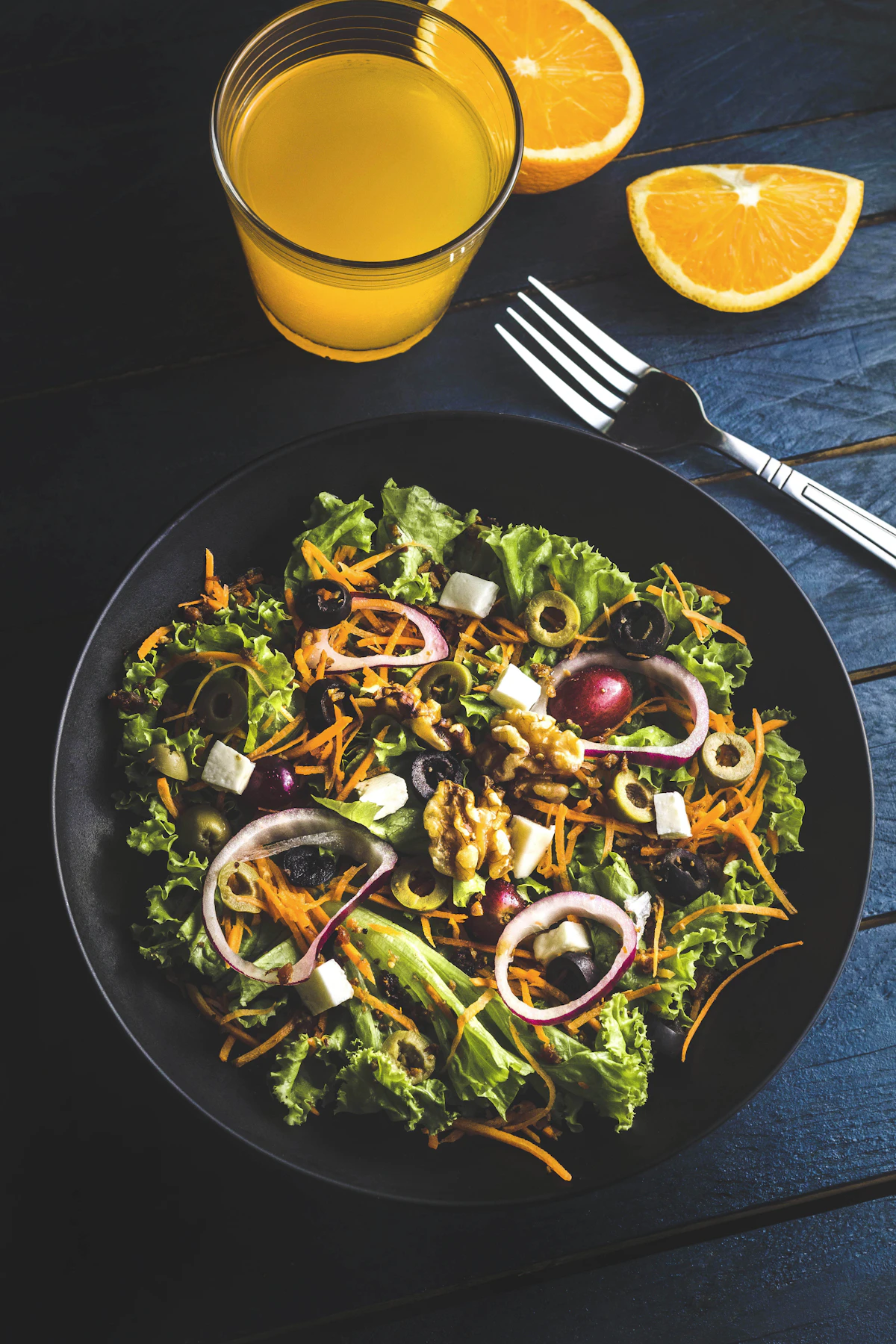
Most nutrition advice tells you to change what you eat. A small but growing body of research asks a stranger question: what happens if you eat exactly the same meal, with the same calories and the same macros, but change the order of the courses?
The answer turns out to be more interesting, and more complicated, than the headlines suggest.
The study that started the conversation
In 2015, a team at Weill Cornell Medical College ran a deliberately simple experiment. Eleven adults with metformin-treated type 2 diabetes ate an identical 628-calorie Western meal (55 g protein, 68 g carbohydrate, 16 g fat) on two occasions a week apart.
On one visit they ate the carbohydrate first (ciabatta bread and orange juice), then waited 15 minutes before the chicken and vegetables. On the other visit they reversed it: vegetables and protein first, carbohydrate 15 minutes later.
Same food. Same calories. Same people. Only the order changed. The results:
- Blood glucose was 28.6% lower at 30 minutes, 37.0% lower at 60 minutes, and 16.8% lower at 120 minutes when carbohydrate came last.
- The total glucose rise over two hours (incremental area under the curve) was 73.5% lower.
- Insulin release over two hours was 48.5% lower, meaning the body handled the same carbohydrate load with substantially less insulin.
The authors noted that the size of the effect was "comparable to that observed with pharmacological agents that preferentially target postprandial glucose." That is a striking sentence to find in a paper about the order of courses on a plate.
It deserves an equally clear caveat, and the authors gave one: this was a pilot study of eleven people, measured for only two hours, in a group who already had type 2 diabetes. It is a compelling signal, not a finished case.
Why would order matter at all?
Digestion is not a blender. Food leaves the stomach at different rates, and what arrives first changes how the rest is handled.
Two mechanisms do most of the work:
- Slower gastric emptying. Protein, fat and fibre reaching the stomach first slow the rate at which the later carbohydrate is delivered to the small intestine. Glucose then enters the bloodstream as a gentler curve rather than a spike.
- Incretin hormones. Protein and fibre arriving first trigger release of GLP-1, the same hormone system targeted by drugs like semaglutide. GLP-1 slows stomach emptying further and improves the insulin response to the glucose that follows.
The PATTERN study tested this directly in 16 healthy adults using a typical Asian meal of vegetables, chicken breast and white rice, served in five different sequences. Eating vegetables first, then meat, then rice produced a lower glucose response and higher GLP-1 release than rice-first, without demanding more insulin. The mechanism and the outcome lined up.
Does it work in people without diabetes?
This is the question that matters for most readers, and the evidence here is younger.
A 2025 study at Kansai Electric Power Hospital in Japan took the idea out of the laboratory and into a staff cafeteria. Healthy adults (average age 33, average BMI 21.9, average HbA1c 5.2%) wore continuous glucose monitors while eating real Japanese set meals and beef rice bowls, prepared by a dietitian and eaten under observation to confirm the order was followed. Glucose was tracked for four hours.
Eating the non-rice components before the rice significantly reduced the glucose rise compared with eating rice first or eating everything together. The effect held with real, varied cafeteria food rather than standardised test meals.
A 2025 systematic review pooled six studies from Indonesia, the United Arab Emirates, Singapore and Japan, covering 107 healthy participants aged roughly 20 to 37. Its conclusion was measured: meal sequencing "may attenuate acute postprandial blood glucose responses in healthy adults," with effects clearest when vegetables, fruit or protein-rich food came before the carbohydrate. The reviewers explicitly called for longer trials across more diverse ages, ethnicities and metabolic conditions, because that is what the field still lacks.
How much of a head start do you need?
The Japanese cafeteria study is useful here because it tested several gaps rather than one. Participants ate the non-rice portion 15, 10 or 5 minutes before the rice, or ate everything together, or ate rice first.
All three head starts, including the five-minute one, significantly reduced the glucose rise compared with eating rice first. You do not appear to need a rigid quarter-hour pause. Starting with the salad and the protein and simply getting to the bread or rice a few minutes later captured much of the benefit.
The reality check
Here is where most articles on this topic stop, and where the picture gets genuinely more informative.
A 2025 study published in Nature Medicine ran a far more rigorous version of the experiment. Fifty-five thoroughly profiled participants wore continuous glucose monitors through seven different standardised 50 g-carbohydrate meals, each repeated, producing 848 glucose curves. A subset of 32 people then tested "mitigators": 10 g of pea fibre, 10 g of egg-white protein, or 15 g of cream, eaten 10 minutes before a rice meal.
All three preloads did significantly reduce the glucose peak. But the average effects were small, with effect sizes (Cohen's d) of 0.12 for fibre, 0.19 for protein and 0.05 for fat. Nothing resembling a 73% reduction.
More importantly, the average concealed enormous variation between individuals:
- Most people benefited, but not all: fibre helped 23 of 32 participants, protein 22, and fat 20.
- Some participants showed a higher glucose response when they used a preload.
- Preloads were less effective in insulin-resistant participants than in insulin-sensitive ones, which is an uncomfortable finding, because insulin-resistant people are precisely the group most often told to try this.
- Protein worked best in people whose glucose spiked most sharply on rice to begin with.
So why the gulf between 73% and an effect size of 0.19? The most likely explanation is dose. The Weill Cornell study front-loaded an entire course: 55 g of protein plus two vegetable dishes, 15 minutes ahead. The Nature Medicine study used 10 g of a single isolated nutrient, 10 minutes ahead. Those are very different interventions wearing the same label. A token bite of something before your pasta is not the same as eating a real salad and a real portion of protein first.
What this actually means for your next meal
Read together, the evidence supports something modest and genuinely useful, rather than a hack:
- Order is a free variable. It costs nothing, removes no food, and requires no tracking. Even if your personal effect is at the small end, the downside is zero.
- Make it a real course, not a token bite. The largest effects came from a substantial serving of vegetables and protein first. This is the part most people get wrong.
- A few minutes is enough. Five minutes of head start showed a measurable effect. Perfection is not required.
- It is a complement, not a substitute. Total carbohydrate quantity and quality remain the primary drivers of your glucose response. Sequencing adjusts the curve; it does not rewrite the meal.
- Expect individual variation. Some people respond strongly, some barely at all, and a minority respond in the wrong direction. Population averages do not tell you which one you are.
In practice this is unglamorous: start with the salad and the protein, get to the rice, bread, pasta or potatoes a few minutes later. That is the whole intervention.
How to find out whether you are a responder
The most consistent finding across this literature is not the size of the average effect. It is how much people differ from one another. The same meal, in the same order, produces meaningfully different responses in different bodies.
That makes this a question your own data can answer better than any study average. If you keep a food diary, the useful experiment is a boring one: eat the meals you normally eat, log them the way you normally log them, and change only the order for a couple of weeks. Watch how you feel in the two hours afterwards, particularly the afternoon energy dip that often follows a carbohydrate-first lunch. If you have access to glucose data, watch that instead.
A logging habit turns a population-level finding into a personal one. That is the honest use of research like this: not as a rule to obey, but as a hypothesis worth testing on yourself.
The bottom line
Eating carbohydrate last measurably lowers the glucose and insulin response to a meal. The effect is real, mechanistically well explained, and reproduced across several countries and study designs.
It is also smaller and less universal than the most-quoted figure implies. The 73% reduction came from eleven people with type 2 diabetes eating a full protein-and-vegetable course first. The rigorous 2025 replication using small isolated preloads found modest average effects, wide individual variation, and weaker results in exactly the people who need help most.
Which leaves a reasonable conclusion: reorder your plate, because it is free and the evidence leans positive. Just hold it as an experiment on yourself rather than a law of metabolism.
References
- Shukla AP, Iliescu RG, Thomas CE, Aronne LJ. Food Order Has a Significant Impact on Postprandial Glucose and Insulin Levels. Diabetes Care, 2015;38(7):e98–e99.
- Sun L, et al. Postprandial glucose, insulin and incretin responses differ by test meal macronutrient ingestion sequence (PATTERN study). Trial registration NCT03533738.
- Kajiyama S, et al. Sequence of Eating at Japanese-Style Set Meals Improves Postprandial Glycemic Elevation in Healthy People. Nutrients, 2025;17(4):658.
- Individual variations in glycemic responses to carbohydrates and underlying metabolic physiology. Nature Medicine, 2025.
- Effects of meal sequence intervention on blood glucose response in healthy adults: a systematic review, 2025.
This article is general information, not medical advice. If you manage diabetes or take glucose-lowering medication, talk to your clinician before changing how you eat, since altering your glucose response can affect medication timing and dosing.